Combine encoding and application processing on one device.

Build your own low-code Edge Application, license one from a third party, or deploy a free app. Push applications to devices already in the field, update or replace them as workflows change, and monitor them across the fleet through LiveEdge® Cloud.
Deploy in days—not weeks or months.
One platform, fewer boxes
Like applications on an iPhone, Edge Apps add new capabilities after the hardware is deployed. Use them to solve real-world monitoring, advertising, graphics, transport and video workflow problems without adding another computer or replacing the device.
Combine encoding and application processing on one device.
Deploy and manage applications across distributed fleets.
Control streaming, recording, graphics and metadata through APIs.
Connect video workflows to SaaS, cloud and control platforms.
Architecture
LiveEdge Compute provides the on-device runtime. LiveEdge Cloud provides the management layer for consistent configuration, diagnostics and application lifecycle control.
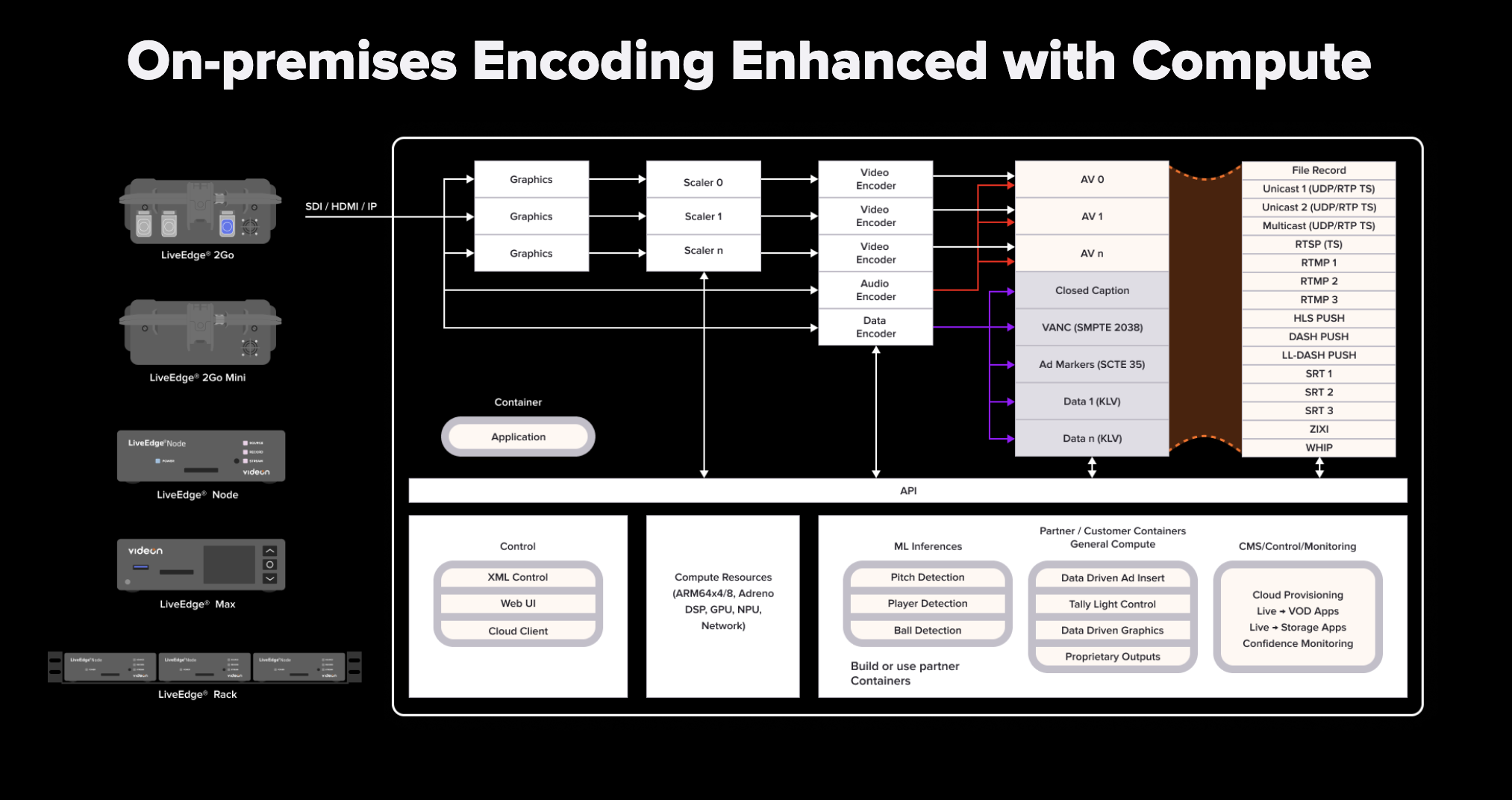
Ingests, encodes, records and delivers professional live video.
Runs containerized applications next to the video pipeline with access to device APIs and approved resources.
Deploys, configures, controls and troubleshoots applications across distributed devices.
Install from the Container Directory or pull custom images from Docker Hub and Amazon ECR.
Apply manifests, environment variables, ports, restart policies, storage and approved device mappings.
View image status and access historical or near-real-time container logs remotely.
Rapid application development
Low-code Edge Applications can be created quickly to solve a specific customer requirement, deployed directly on the video device, and managed remotely without waiting for a full appliance firmware release.
From idea to Edge App
Focused software, built at workflow speed.Package the application and its dependencies once, validate it with the target video workload, then deploy it consistently across the fleet through LiveEdge® Cloud.
A customer needed recorded content to be ingested automatically into its SharePoint account for archive and downstream access.
The initial Edge Application was developed in two days. Running directly on the Edge Device, it monitors completed recordings and transfers the content into the customer's SharePoint workflow—without adding a separate transfer computer.
Working in collaboration with



Prototype in progress
This prototype is being developed in real time over three days. It demonstrates how a low-code Edge Application can explore and validate a customer-requested capability without changing the native encoder or encoded essence.
Contribution and distribution workflows increasingly require path redundancy across unmanaged IP networks. A single RIST output can recover isolated packet loss through retransmission, but it cannot preserve service when its only network path fails.
The requirement is a redundant RIST output that a receiver can merge at the packet level in a manner compatible with SMPTE ST 2022-7 seamless protection workflows.
Replacing appliance firmware or adding RIST to the native encoder output would lengthen the development, validation and release cycle.
A LiveEdge container provides a lower-risk integration point: it consumes the encoder's existing UDP output without changing the encoded essence, then adds transport reliability and path duplication as a separate function.
This RIST prototype is an active R&D effort—not a generally available production feature—and an example of the monitoring, transport-resilience and contribution problems Videon is working to solve.
The sender accepts raw MPEG-TS datagrams on UDP port 5014, validates datagram alignment and transport-stream continuity, buffers short input bursts, and forwards the unchanged payload to libRIST. It does not transcode, decode or remultiplex the program.
Receives encoder MPEG-TS traffic on UDP port 5014.
Audits 188-byte packet alignment, sync bytes, transport error indicators, continuity counters, application queue drops and kernel socket drops.
Creates two libRIST peers with weight zero so every source packet is sent across both network paths.
Uses Simple Profile endpoints at the AWS Elemental MediaConnect-assigned base ports, with adjacent RTCP and NACK control ports.
Reports peer quality, bitrate, round-trip time, retransmissions and connection state through container logs.
Restarts automatically under the container runtime if the process exits unexpectedly.
The container adds redundancy and diagnostics around the existing encoder output; the video essence remains unchanged.
Application portfolio
| Application | Status | What it does | Business value |
|---|---|---|---|
| Cloud Storage Uploader | Testing | Uploads completed recordings to SharePoint Online, Amazon S3 or both. | Automates file delivery without a separate transfer computer. |
| S3 HLS Processor | Production | Sends HLS playlists and segments directly from NODE or MAX to Amazon S3. | Simplifies direct-to-cloud streaming, playback and archiving. |
| LiveEdge® Graphix | Production | Renders an HTML5 URL as a graphic overlay on the input stream. | Adds scores, clocks, branding and data-driven graphics without another computer. |
| SCTE Marker Insertion | Production | Maps USB keyboard controls to SCTE-35 marker insertion and cancellation. | Provides local control of advertising and segmentation events. |
| LiveEdge® Switcher | Production | Switches between a live source and media stored in four playback slots. | Combines encoding, playback and basic switching in one workflow. |
| RTSP Input | Production | Connects an RTSP stream as a Videon Software Input. | Simplifies repeatable use of IP cameras and other RTSP sources. |
| Tailscale | Production | Establishes a private VPN connection for authorized troubleshooting. | Enables controlled remote technical access. |
| Network Analyzer | Partner app | Identifies network conditions that could disrupt a live broadcast. | Improves deployment readiness, reliability and uptime. |
| GPI Trigger | Partner | Connects workflow-specific GPI trigger hardware to the Videon platform. | Integrates existing physical controls without another control computer. |
| Bitfocus Companion | Evaluation | Runs Companion on NODE or MAX with potential USB Stream Deck support. | Could eliminate a separate Companion computer. |
| DASH HTTP Push | Alpha | Translates Videon DASH output to customer-specific specifications. | Provides compatibility for a specialized delivery requirement. |
| WebRTC Server | R&D | Receives WHIP from the device and delivers WHEP to a browser. | Explores direct, low-latency browser monitoring. |
| Edge Clipping | Proof of concept | Explores extracting or creating clips directly at the edge. | Could reduce the infrastructure and time required to create clips. |
Device platforms
Applications must be validated on the intended device, software version and video workload. Compatibility on one platform should not be assumed for another.
Suited to targeted applications running alongside professional encoding.
Greater capacity for more demanding applications and multi-input workflows.
Bring applications to the edge
Combine professional live video with containerized applications, cloud management and APIs across your distributed fleet.
Talk to Our Team